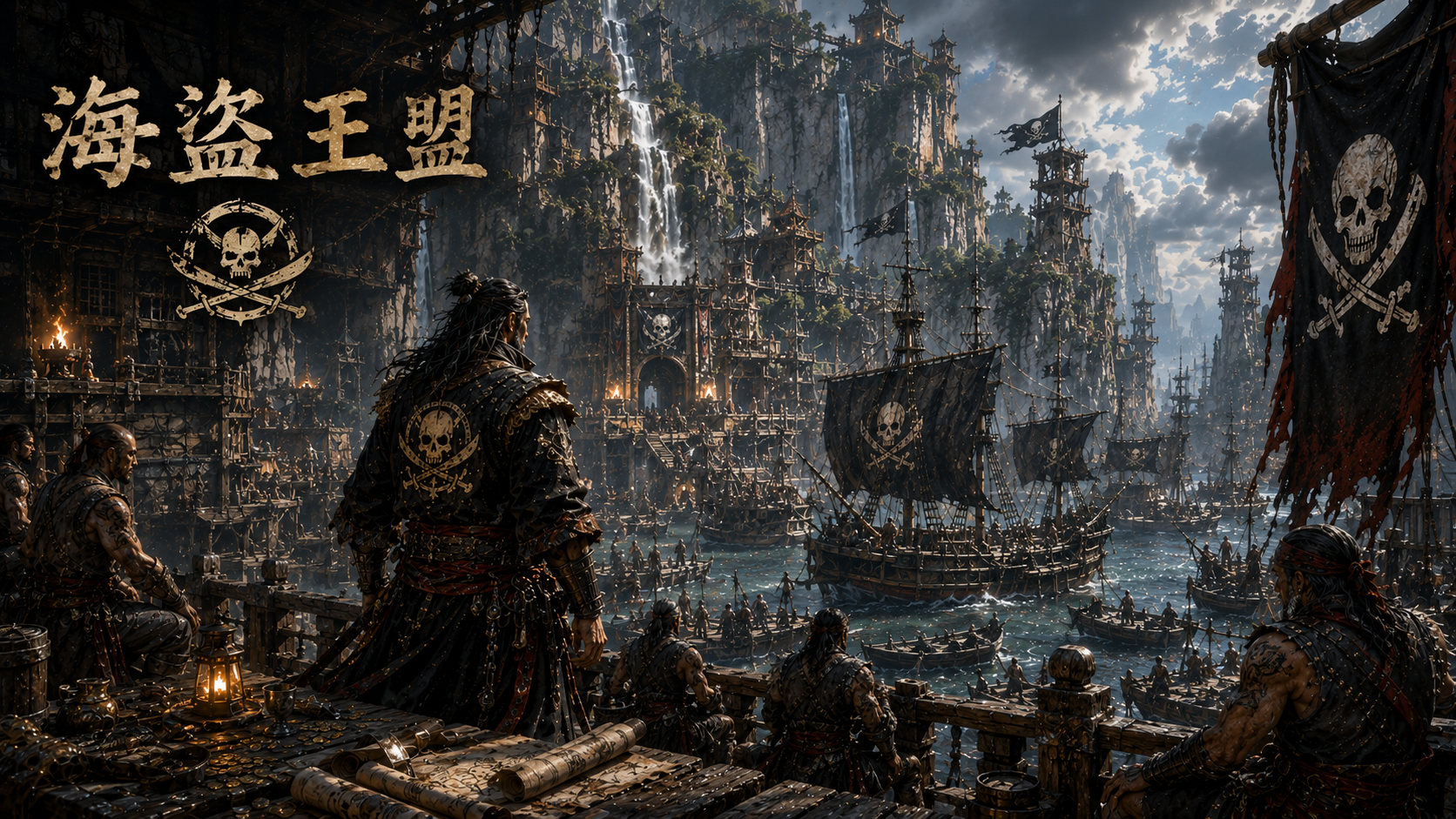
☠️ Pirate Alliance (Pirate King’s League)
🔹 Aliases: Overlords of the Five Seas, Pirate Council
🔹 Creed: Lawless, only the strong are king, ruling the seas, plundering wealth
🔹 Headquarters: "Port of Black Tides" (a hidden pirate city within the Commercial Republic)
🔹 Nature: Pirate alliance, controlling maritime trade routes and maritime hegemony
📖 Organizational Background
The Pirate Alliance is the most powerful maritime force in the Commercial Republic, composed of pirates from all over the world. Their goal is to rule the five seas, monopolize all maritime trade, and establish a kingdom of their own.
Hundreds of years ago, the waters of the Commercial Republic were a lawless zone where various pirates, privateers, and smugglers ran rampant. They were both raiders and a foundational part of the republic's trade. However, as the Wealth Sect began monopolizing the economy, many pirates found themselves excluded and unable to compete with formal merchant associations. Thus, they decided to unite, sharing intelligence, resources, and military power to form the Pirate Alliance, transforming from independent raiders into sovereign overlords of the sea.
Members of the alliance come from all walks of life, including defected naval officers, smugglers, slave traders, exiled warriors, bounty hunters, and adventurers. They reject the rule of governments and commercial alliances, believing in the principle that "might is right." As long as you can conquer the ocean, you can hold the highest status in this organization.
Their greatest enemy is the Wealth Sect, the plutocratic alliance that seeks to monopolize all maritime trade and squeeze pirate survival space, even placing bounties on their heads. The conflict between the Pirate Alliance and the Wealth Sect has become one of the most intense showdowns in the Commercial Republic.
📖 Organizational Structure
The alliance is managed by the "Pirate Council," where all pirate lords make joint decisions and elect a "Pirate King" as their supreme leader.
👑 The Pirate King
Pirate King: "Blackfang" Drake
🔹 Possesses a blend of cruelty and cunning. Legend says he was once a naval general for a distant western power, pursued for war crimes. He escaped by individual strength, killing everyone in the military camp where he was held, seizing several warships, and transforming into a pirate. Through years of operation, he has become the undisputed king of the western seas.
🔹 Believes that "war is plunder, and plunder is rule," asserting that pirates should be rulers of the sea, not just outlaws.
🔹 Leads the "Black Tide Fleet," the most powerful fleet in the alliance, controlling the most dangerous routes and fortresses.
⛵ The Pirate Council
Council Members: Composed of the leaders of various pirate groups, responsible for their own territories while participating in major decisions.
- 🔹 "Tempest" Captain Morgan — The most notorious swordsman on the sea, expert in double-handed swords and naval strategy. He appears aged, wearing a weathered tricorn hat and a tattered coat, with a black-and-green parrot on his shoulder. Legend says he has the mysterious power to summon fog and manipulate ocean currents. His ship is the legendary "The Mist," which often emerges from the sea spray.
- 🔹 "Crimson Queen" Isabelle — A beautiful and deadly pirate, expert in allure, deception, and assassination, controlling black-market trade. She often holds a 12-sided gold die, the legendary "Fate Goddess of the Sea," using its results to guide her actions, believing it to be the ocean's instruction.
- 🔹 "Ironfist" Jack — A giant known for tearing enemies apart with his bare hands. He manages docks and slave markets.
- 🔹 "Revenant" Vigo — An executed pirate who miraculously survived. He is an expert in eerie assassination tactics and has his own "Specter Afterimage Gun Dance" combat style.
⚔️ Martial Arts of the Pirate King's League
The League's martial arts are bound by no traditional sect's rulebook — every one of them was ground out of deck fighting: brawling through wind and swell, killing on the boarding rush, staying alive in a harbor alley. What matters is agility, lethality, and hard experience, not moves that look good.
The League's system has three layers. An art is a discipline you train and level (1–100); the Pirate King's League has seven of them. A technique hangs beneath a particular art, cannot be learned until you reach a required level in that art, and costs inner force with a cooldown when performed. An exert also hangs beneath an art, but it does not strike the enemy — it puts you into a heightened state.
🧭 Tide Sailing — Foundation of the Whole League
Governing skill: seamanship.
"No blade ripens ashore." — the first iron law of the Pirate Council at the Port of Black Tides.
Tide Sailing is not a killing art; it is the root of every pirate art there is. Reading wind and tide, working the helm to steal the weather gauge, standing on a pitching deck as though on flat ground, taking root underfoot on the boarding rush. The deeper this runs, the more your inner force, your blade pressure, and your footwork will actually answer when the fighting starts. A pirate who never puts to sea is capped by nature.
The cap rule: the level ceiling of the other six arts equals your Tide Sailing × 1.5 (then further limited by each art's own weapon skill — the lower of the two applies).
- 🔹 Tide Sailing 20 → the six arts cap at 30
- 🔹 Tide Sailing 40 → the six arts cap at 60
- 🔹 Tide Sailing 67 → the six arts cap at 100 (fully open)
Seamanship accumulates through voyages, sea raids, and practice on deck — live an ordinary pirate's life and it advances on its own.
🌊 Storm Heart — Internal Art
Governing skill: inner force.
The internal art passed down in secret by the Pirate Council, named for the storm that never leaves the Port of Black Tides. Nothing kills faster at sea than being alone; what this art cultivates is exactly the breath that strengthens as things worsen — hemmed in on all sides, wolves closing, the inner force in your chest does not retreat but presses forward, burning hotter, turning fear into killing intent. Only those who come out of a melee alive are fit to stand on the Pirate King's deck.
Trait: when surrounded by two or more enemies, accuracy, critical rate, and damage reduction all rise together with your level and the number of attackers — the only art in the League that gets stronger the worse you are outnumbered.
🗡️ Tidal Blade — The League's Signature Blade
Governing skill: blade (also governs parry).
Blade held level on a pitching deck, its pressure like breakers against a hull — each wave higher than the last, each stroke stacked on the one before, giving the opponent no room to breathe, until he goes over the side with blade and shield still in hand. At its most formidable when boarding.
Aboard-ship bonus: on deck, accuracy ×1.2 and damage +10%.
- 🔹 Technique — Raging Wave (requires Tidal Blade 10) — a fast linked cut. The blade builds like stacking swell: one stroke has not landed before the next begins, two cuts each striking separately, each rolling its own hit and damage, the following wave shoving the leading one until the man is backed against the rail. The most practical follow-up kill in a close grapple.
- 🔹 Technique — Blood Tide (requires 40) — the closing blow. Every scrap of inner force is pressed onto the edge and brought down in one stroke, like a blood tide washing the deck. Everything is on this one cut: either it lands huge and takes the life, or it is dodged clean and wastes. The inner-force cost is enormous; nobody spends it except to finish.
- 🔹 Exert — Tide Dance (requires 20) — high-tier channeling. The blade follows the swell and the body follows the blade, one man dancing himself into a whole crest of water; the blade-light rolls like surf, turning aside edges from every quarter while driving your own blade pressure faster and harder. Lasts roughly four rounds, with dodge and output scaling on the art's level.
🔫 Tidal Gun — Firearms
Governing skill: gunnery.
Inherited from the Commercial Republic's firearms, yet grown into its own road out on the raging sea: aim hardly matters, volley and suppression are everything. A rank of muskets ranged along the rail fires as one, and the boarders come up through the smoke; up close it is a barrel against the chest and one shot, shot sweeping the deck, the noise alone enough to break men.
Aboard-ship bonus: on deck, accuracy ×1.5 and damage +20% — the fiercest aboard-ship bonus of any art in the League.
🔫 Gunfu — Confluence of Three Arts
Governing skill: two-handed weapons (also gunnery and parry).
A firelock in each hand — yet not standing off at a distance to shoot. The guns are treated as extensions of the body. Elbow, knee, shoulder, wrist: there is no part of him that is not a move. Reversed, the barrel is a bludgeon; the butt driven into the short ribs is crueler than a fist; a step in and a clamp on the wrist takes the weapon out of his hand. Spinning, diving aside, firing backward over a reversed arm — one of the two muzzles is always on the man. Running dry is no cause for alarm: a shake of the sleeve brings out a fresh charge.
Planks are narrow and formations are chaos when pirates take a ship; a long musket has no room to work and a blade cannot be drawn fast enough. Those are the conditions this art was ground out of — a man who has mastered it does not let an opponent close the gap between two reports, because he is already pressed against the opponent himself.
[Confluence of Three Arts] This is the hardest art in the Pirate King's League to bring to fruition. It is the confluence of firearms, parry, and hand-to-hand, and its attainment is bounded by whichever of the three is weakest — however true the shooting, a man who cannot turn a blade aside and cannot close the distance will find his Gunfu simply stops there. Only when all three advance abreast does it gain an inch. So too in a fight: the guns answer to Tidal Gun, the parry is made with the twin firelocks, and the two hands fire in alternation — all three must be running at once, and lacking any one of them the art is as good as untrained. (Parrying with twin firelocks is less steady than training the gun alone; that is the trade.)
- 🔹 Technique — Gun Dance — the summit of Gunfu. The twin firelocks are no longer weapons but extensions of the body; turning aside what comes while pressing in close, finding the gap between the opponent's raised hand and its return, shot after shot at arm's length; once he is caught up he is not let go, and there is not half a step of room left to give ground. After it is performed, the opponent has no leisure to strike back for several rounds (the count growing with attainment), and through all of it the man's every round is another shot. The inner-force cost is enormous, and it comes around only rarely.
👊 Pirate Style — Unarmed
Governing skill: unarmed (also governs dodge).
The killing craft of the boarding rush, of taking a life at arm's length. Blade and gun have no room to work on a narrow plank, so the pirate answers with fist, elbow, knee, and teeth — shatter the joint, lock the throat, trade life for life. Whatever puts the man down is a good move; there is not one line of form in it.
- 🔹 Technique — Crush (requires Pirate Style 8) — the opening kill. Never the soft flesh; always the joint. One fist into a shoulder, an elbow, or a knee, and the bone goes out of true and the tendon goes with it — the opponent's parry and dodge both fall off sharply on the spot. The first thing a pirate shows in a boarding brawl.
- 🔹 Technique — Shark Bite (requires 22) — closing in and locking a man down the way a shark sets its teeth in prey. One hand clamps the wrist and strips the weapon, the other winds around the body and will not let go, so he can neither draw his blade nor break free. On a hit it separately attempts a disarm and a bind (each rolled independently — both can land at once) — precisely the League's signature hold for taking a prisoner alive or pinning a ship's master.
🦶 Tidal Steps — Footwork
Governing skill: dodge (also governs footwork).
Footwork like a drunk walking on swell — all lurch and stagger, no root underfoot, and in truth using the deck's own roll to shed every edge that comes. To a trained eye the man looks about to go over the side, yet the enemy's blade always falls where he was standing a moment ago. The more the planks pitch, the livelier the footwork gets — the pirate's own art for staying alive on top of a wave.
Aboard-ship bonus: on deck, dodge ×2.
Of the seven, the aboard-ship bonuses apply only on deck, and only to someone who has trained Tide Sailing himself — the sharpest signature this League has. Ashore, a pirate is just another fighting man; the moment he sets foot on his own planking, the blade lands truer, the gun bites harder, and the body slips away cleaner.
🏅 Standing in the League (Renown × Tide Sailing, ten ranks)
A League disciple's standing is set by two thresholds at once: renown within the League and attainment in Tide Sailing. A man who cannot sail is just a thug on the shore no matter how known his name is; a man who can sail but carries no standing is nobody the League recognizes either.
Hence ten ranks, from the bottom up:
- 🔹 1 · Signed-On Hand — your name has just gone into Jack's ledger; nobody in port knows you yet.
- 🔹 2 · Seasoned Hand — a few voyages in, and you can hold your feet when the swell runs high.
- 🔹 3 · Helmsman — the helm is handed to you; you can put to sea and raid on your own.
- 🔹 4 · Gun Captain — the gun positions are yours to direct, and the black market's door opens to you as well.
- 🔹 5 · Deck Boatswain — a whole ship's crew answers your shout, and the second floor of the League stores is opened to you.
- 🔹 6 · Black Tide First Mate — with the captain away, you are the one who speaks aboard.
- 🔹 7 · Raiding Captain — a ship of your own and a crew of your own — only now will Drake look you in the eye.
- 🔹 8 · Black Tide Captain — run your flag up and merchantmen put about; the fleet-line assignments start coming your way.
- 🔹 9 · Fleet Commander — more than one ship under you. The top floor of the League stores opens for you.
- 🔹 10 · Black Flag Admiral — the summit for a disciple, below only the Council's four seats and the Pirate King himself.
Above the ten ranks stand the Council's four seats and the Pirate King himself, who are not counted among the disciple ranks.
📜 External Relations
- 1. Wealth Sect 💰: Mortal enemies. The alliance views them as the greatest obstacle to maritime hegemony; naval battles and trade conflicts are frequent.
- 2. Changfeng Republic Gangs 🤝: Certain gang forces like the "Fist Gang" have cooperative relations with the alliance, involved in smuggling and human trafficking.
- 3. Shuntian Dynasty Navy ⚔️: Hostile. The dynasty has tried to suppress the pirates but has been unable to eradicate them due to internal and external pressures.
- 4. Kaga Clan 🔥: Some ninjas have been hired by the alliance for assassinations and espionage, though the relationship remains unstable.